
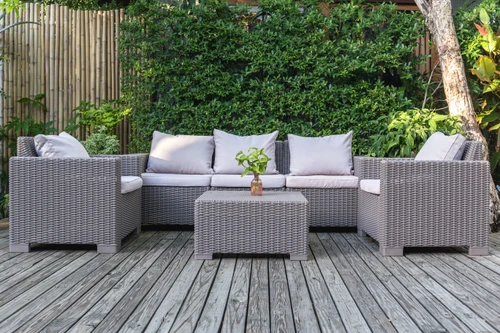
Outdoor Furniture: How to Pick the Right Furniture and Decor for Your Home
Posted by Admin on 21st Aug 2026
TL;DR: Quick Answers
- What should you look for first when buying outdoor furniture? Start with how you will actually use the space, then measure the patio and choose furniture that fits the activity, circulation, climate, and maintenance you are willing to handle.
- What material is best for outdoor furniture? There is no universal winner. Powder-coated aluminum is versatile and relatively lightweight, sling seating drains quickly, cushions provide deeper comfort, HDPE can simplify maintenance, and wood offers a natural appearance with material-specific care requirements.
- Should you choose cushions or sling furniture? Choose cushions when lounge comfort is the priority. Choose sling seating when faster drying, airflow, and reduced cushion storage matter more.
- How should you arrange patio furniture? Build zones around what happens there. Dining furniture belongs near serving and cooking routes, while lounge seating should face a fire feature, view, pool, coffee table, or another intentional focal point.
- How much furniture should you put on a patio? Less than you can physically fit. Leave space for chairs to move, people to walk, doors to open, grills to operate, and fire features to maintain required clearances.
- What holds up best near a pool or coast? Material selection becomes especially important around chlorine, salt, humidity, and repeated wetting. Confirm the specific manufacturer's recommendations rather than assuming every piece labeled "outdoor" is equally suited to these exposures.
- Should your outdoor furniture match your planters and decor? Coordinate rather than match everything exactly. Repeating a limited palette of finishes, colors, shapes, or materials usually creates a more deliberate outdoor room.
Choosing outdoor furniture is less about finding the most attractive sofa or dining set and more about building an outdoor room that works for the way you live. The furniture needs to physically fit your patio, remain comfortable for its intended purpose, make sense in your climate, and work with the planters, fire features, shade, landscaping, architecture, and other decor around it.
Real-world buyer discussions repeatedly come back to the same issues: whether aluminum, teak, HDPE, or another material will hold up, whether cushions are worth the maintenance, how furniture performs in coastal climates, and how to arrange dining and lounge areas without blocking circulation.
The right answer depends on your property, but there is a reliable process for narrowing the choices.
Start With How You Will Use Your Outdoor Furniture
Before comparing frame materials or fabric colors, decide what you want to do outside.
A patio designed for Sunday dinners needs a different layout from a pool deck, rooftop lounge, fire-pit conversation area, hotel terrace, or small balcony. Trying to make one furniture arrangement perform every possible function often results in an overcrowded space that does none of them particularly well.
Yard Couture's current outdoor patio furniture collection includes dining tables and sets, individual chairs, cushion furniture, sling seating, sofas, chaises, side tables, and other pieces from brands including Homecrest Outdoor Living and Zuo Modern.
Outdoor Dining
If outdoor meals are the priority, start with the number of people who normally use the table rather than the largest group you might host once or twice each year.
Look at the entire dining footprint. A six-person table is not just the size of the tabletop. Every chair needs room to pull backward, and people need to move behind occupied chairs without constantly asking someone else to stand up.
Also consider the path between your kitchen, grill, and table. The shortest practical serving route is usually preferable to carrying food through a lounge area or around a fire feature.

Lounging and Conversation
For a more relaxed outdoor living room, sofas, loveseats, lounge chairs, swivel chairs, ottomans, and modular sectionals make more sense.
Comfort should be evaluated alongside scale. Deep seating may feel excellent but can consume a surprising amount of patio depth. Measure seat depth, arm width, sectional configuration, and the space necessary to walk around the arrangement.
Modular pieces are especially useful when you want flexibility. They can allow a larger patio, hospitality terrace, or amenity deck to be configured differently depending on use.

Poolside Furniture
Poolside furniture sees different conditions than furniture beneath a covered porch. Wet swimsuits, chlorinated or saltwater pool systems, sunscreen, direct sunlight, and frequent cleaning can all influence material and fabric selection.
Chaise lounges and sling chairs are often practical because they reduce the amount of loose cushioning you need to manage, but you should still confirm the construction and care requirements of the specific model.
Small Patios, Balconies, and Rooftops
On a compact patio, every piece should justify the space it occupies.
Look for appropriate-scale dining tables, café chairs, stackable options where available, side tables that can serve multiple purposes, and furniture that preserves access to doors and railings.
Rooftops and exposed balconies introduce another concern: wind. Lightweight furniture may be convenient to reposition, but low weight is not automatically an advantage in an exposed environment. Structural loading should also be professionally evaluated where the supporting capacity of a balcony or roof is uncertain.
How to Pick the Best Outdoor Furniture Material
Material should be selected based on exposure, maintenance, weight, comfort, and appearance, not simply on which material sounds the most durable.
| Material or Seating Type | Main Advantage | Main Consideration | Good Applications |
|---|---|---|---|
| Powder-coated aluminum | Lightweight, versatile and corrosion resistant | Finish still requires care, especially around salt | Dining, lounge, sectionals, poolside furniture |
| Steel | Weight and structural strength | Coating condition and corrosion management | Tables, benches, heavier furniture |
| HDPE | Moisture resistance and relatively simple care | Quality, construction and surface temperature vary | Chairs, tables, casual seating |
| Sling fabric | Fast drainage, airflow, no loose seat cushion | Fabric tension and eventual replacement | Dining chairs, poolside seating, chaises |
| Outdoor cushions | Deep comfort and broad fabric selection | Cleaning, drying and storage | Sofas, club chairs, sectionals |
| Rope or woven material | Adds texture and softer visual character | Weave quality and weather performance vary | Lounge chairs, sofas, accent seating |
| Hardwood | Natural warmth and texture | Species and finish determine care needs | Benches, tables, accent furniture |
Powder-Coated Aluminum
Aluminum is heavily represented in Yard Couture's current furniture assortment. It is useful outdoors because it combines relatively low weight with corrosion resistance and can accept durable architectural finishes. Yard Couture currently carries aluminum dining chairs, sofas, sectionals, chaises, sling seating, and tables.
Powder coating adds a finished exterior rather than leaving the aluminum raw. That gives you significantly more control over color and helps protect the underlying metal.
Do not interpret that as maintenance-free.
Homecrest's current warranty documentation, for example, specifically requires additional maintenance for painted surfaces exposed to salt air, including regular cleaning and waxing. That illustrates why "outdoor rated" does not mean "ignore it indefinitely."
Sling Furniture
Sling seating uses a tensioned outdoor fabric to create the seat and back rather than relying on thick removable cushions.
This configuration makes sense when you value airflow and quick drainage or simply do not want to store cushions whenever severe weather approaches.
Yard Couture's current outdoor sling furniture collection includes dining chairs, chat chairs, chaise-style seating and other aluminum-frame configurations.
Sling furniture is particularly worth considering for pools, humid climates, rental properties, hospitality spaces, and owners who prefer simpler daily upkeep.
It still requires inspection and cleaning. Slings can eventually wear or lose tension, so replacement availability can become an important long-term purchasing question.
Cushioned Outdoor Furniture
Cushioned seating usually offers the closest experience to an indoor living room. The tradeoff is that fabric and cushion construction become important parts of the purchase.
Look beyond color.
Ask what fabric is used, how the cushion handles moisture, whether the covers can be removed, what cleaning process the manufacturer allows, and whether replacement cushions can be ordered later.
Sunbrella, a major outdoor fabric manufacturer, advises owners to use mild soap and water for routine upholstery cleaning and to allow fabrics to air dry. It also cautions that furniture construction varies, so you should consult the furniture manufacturer before removing or machine-washing cushion casings.
HDPE and Other Outdoor Polymers
HDPE, or high-density polyethylene, is used in some outdoor furniture because it does not respond to water the same way untreated wood or ferrous steel does.
That does not make every HDPE product equal. Thickness, joinery, fasteners, UV stabilization, frame design, and manufacturing quality can differ considerably.
This is also a good example of why the phrase "best outdoor furniture material" has no simple answer. Buyer discussions frequently compare HDPE with aluminum and teak because each solves a different combination of appearance, weather exposure, maintenance, and budget concerns.

Rope, Woven Furniture, and Wood
Woven rope can soften patios dominated by glass, stone, concrete, or metal. Yard Couture currently carries Homecrest seating that pairs powder-coated aluminum frames with handwoven outdoor rope.
Wood provides another useful contrast. Hardwood benches or table components can add warmth beside metal furniture and architectural planters.
With any wood furniture, however, the species and finish matter. Do not apply generic teak-care advice to every hardwood or assume every wood product should be sealed the same way.
How to Choose Outdoor Furniture for Your Climate
The label "outdoor furniture" covers products used everywhere from coastal Florida to Arizona, Minnesota, and exposed mountain properties. Those environments do not create the same demands.
Hot and Sunny Locations
In high-sun environments, consider shade, fabric exposure, surface temperature, and how frequently the furniture will sit uncovered.
Dark frames and table surfaces can become uncomfortable in direct sun. Cushions and upholstery also receive more UV exposure in an uncovered location than beneath a roof.
A well-planned umbrella or permanent shade structure may therefore affect comfort as much as the furniture itself.
Wet and Humid Locations
Prioritize airflow and drying.
Cushions that remain wet for extended periods are more burdensome to own than furniture that can drain and dry quickly. Sling furniture or quicker-drying cushion systems may be worth considering.
Avoid placing furniture where roof runoff or irrigation continually soaks it.
Snow and Freeze-Thaw Regions
Find out what the manufacturer recommends for off-season care.
Some furniture can remain outside with appropriate preparation, while cushions, umbrellas, and accessories may benefit from protected storage.
Do not assume one winterization method applies to every material.
Coastal and Poolside Properties
Salt exposure deserves particular attention.
Homecrest's warranty documentation specifically identifies salt-water exposure as requiring increased maintenance of painted surfaces. If you are furnishing an oceanfront terrace, marine-influenced property, or pool deck, check the instructions for the exact frame, hardware, sling, fabric, and finish you are considering.
Measure Before You Buy
One of the most expensive patio-furniture mistakes is discovering that a beautiful set technically fits the patio but does not fit when people actually use it.
Measure the complete outdoor room, including:
- Doors and their swing paths
- Steps and railings
- Columns
- Grill and cooking areas
- Fire features
- Planters
- Pool edges
- Major walking routes
- Utility access
Then draw the furniture in its operating position.
A dining chair pulled out from the table occupies more room. A chaise becomes longer when reclined. A swivel rocker needs space to rotate. A sectional needs a usable entrance to the seating area.
Also trace the delivery route. A large sectional can fit perfectly on a terrace and still fail to make it through the gate, elevator, stair turn, or side yard required to reach that terrace.
Arrange Outdoor Furniture in Zones
A strong outdoor layout usually has hierarchy.
Instead of distributing individual chairs and tables wherever there is open floor space, group furniture around activities.
Build a Dining Zone
Place dining furniture where it has reasonable access to the kitchen or grill without interfering with the cooking area itself.
You should be able to move food to the table while allowing other people to circulate through the patio.
Build a Conversation Zone
Orient lounge furniture around something.
That might be a coffee table, view, pool, fireplace, garden, or fire feature. Furniture placed only against the patio perimeter can sometimes make a large space feel like a waiting room rather than an outdoor living area.
Add Secondary Seating
A bench, chaise, or pair of chairs can create a quieter destination away from the primary gathering area.
Yard Couture's current bench selection includes metal designs, hardwood accents, and planter-bench combinations for residential and commercial outdoor settings.
Coordinate Your Furniture and Garden Decor
Your furniture does not need to match every planter, door frame, fire pit, and piece of architecture.
It should feel related to them.
Start with permanent materials such as stone, siding, decking, pool coping, window frames, masonry, and existing metalwork. These are usually harder to change than furniture cushions or accessories.
Then repeat a few visual cues.
Black or charcoal aluminum furniture can relate to dark window frames. Warm Corten steel can provide contrast against neutral cushion furniture. Wood accents can soften a landscape dominated by concrete and metal.
Yard Couture's architectural metal planters currently include Corten weathering steel, powder-coated aluminum, mild steel, and stainless steel across a wide variety of forms. Those products can be used to frame furniture, divide outdoor rooms, create privacy, or transition between a patio and planted landscape.
The goal is coordination, not repetition.
Plan Fire Pits and Furniture at the Same Time
A fire feature should not be an afterthought once the furniture layout is complete.
You need to account for the fire pit's physical dimensions, required clearances, fuel connection, burner controls, circulation, wind conditions, and combustible surroundings.
Yard Couture's outdoor fire pit collection includes gas and wood-burning options in multiple materials and configurations, but individual burner, fuel, ignition, and clearance requirements vary by model.
The U.S. Fire Administration recommends using outdoor fireplaces and fire pits at least 10 feet from a home or anything that can burn, along with using a metal screen over wood-burning fires to control sparks.
Treat that as general safety guidance, not a replacement for your product manual or local requirements. The authority having jurisdiction, manufacturer instructions, fuel-gas requirements, and site conditions may impose additional restrictions.
Do Not Forget Shade
Furniture comfort can change dramatically depending on the sun.
Before choosing frame and cushion colors, pay attention to the path of the sun across the patio. An attractive lounge chair that sits in direct afternoon sun every day may see much less use than you expected.
Umbrellas can solve this without permanently altering the property. If you use one, verify canopy dimensions, base requirements, wind limitations, opening mechanism, and compatibility with the furniture arrangement.
This deserves planning at the same time as furniture, not after the patio is already full.
Residential and Commercial Furniture Require Different Questions
A homeowner may prioritize softness, comfort, personal style, and occasional entertaining.
A restaurant, resort, apartment amenity deck, or commercial property may place greater emphasis on cleanability, frequent use, replacement components, furniture weight, consistent specifications, and commercial warranty coverage.
Do not assume residential and commercial warranties are identical. Homecrest's current limited warranty, for example, provides different warranty periods for several components depending on whether the product is used residentially or commercially.
Architects, designers, and property managers should verify current product specifications, finish samples, replacement components, warranty language, and commercial-use suitability before specifying a product.
What Does Premium Outdoor Furniture Cost?
There is no useful universal price for premium patio furniture because two sets with similar footprints can be constructed very differently.
Cost can be influenced by:
- Frame construction and material
- Sling, rope, or cushion system
- Fabric grade
- Tabletop material
- Number of pieces
- Modular configuration
- Finish options
- Brand
- Residential versus commercial construction
- Replacement-part support
- Shipping and handling
- Assembly requirements
The more useful question is whether the furniture's construction and ownership requirements match the way you intend to use it.
A less expensive sofa that needs replacement after relatively limited use may provide worse value than a more serviceable product with replaceable cushions, slings, and components. Conversely, paying for commercial construction makes little sense when the additional capability does not solve a problem you actually have.
Shipping and Delivery Need to Be Planned Before Ordering
Premium furniture can arrive very differently from a small boxed patio chair.
Yard Couture's current shipping policy says standard products within the continental United States ship free, with standard shipping generally consisting of curbside delivery and lift-gate unloading when needed. Custom products and additional delivery services can be quoted separately. Confirm the current terms for your specific order before purchasing.
For large furniture, determine who will move it from the curb to the patio and who will complete any necessary assembly.
For commercial projects, also think about loading docks, staging, quantity verification, installation sequencing, temporary storage, and damage inspection.
Outdoor Furniture Maintenance Should Influence What You Buy
If you dislike maintaining cushions, do not buy a heavily cushioned outdoor room because it looks good in a catalog.
If you do not have storage, account for that before choosing umbrellas, loose cushions, and seasonal accessories.
Homecrest recommends periodic cleaning of its furniture and warns against using power washers on its frames and fabrics. Its current replacement guide also documents replacement cushions, slings, glides, and other components across many models, which demonstrates why serviceability deserves attention before buying premium furniture.
Fabric-care instructions are equally product-specific. Sunbrella technical-services director Alan Rampey advises: "Become familiar with the limitations of your outdoor fabrics, and don't use anything too harsh for your textiles."
For more detailed maintenance guidance, Yard Couture already has a dedicated outdoor patio furniture care guide. Because fabrics and finishes differ, compare that general guidance with the current instructions from the furniture manufacturer before applying cleaners or treatments.
Common Outdoor Furniture Buying Mistakes
Buying Before Measuring
Measure the furniture in use, not simply the product footprint.
Furnishing for Rare Events
Design around normal daily or weekly use. You can add temporary seating for unusually large gatherings.
Choosing Material Only by Appearance
Consider humidity, salt, pool water, UV exposure, wind, maintenance, and storage.
Ignoring Cushion Management
Know where cushions will dry and where they will go during severe weather or the off-season.
Filling Every Empty Area
Negative space is useful. It creates circulation and helps focal pieces feel intentional.
Forgetting the Delivery Route
Measure gates, elevators, doors, stairs, and corners before ordering oversized pieces.
Adding Fire Later
Plan the seating zone and fire feature together so required clearances and circulation can be addressed from the beginning.
Ignoring Replacement Parts
Ask whether you can replace slings, cushions, glides, hardware, or sectional modules several years later.
Questions to Ask Before Ordering Outdoor Furniture
- How will you use the patio most often?
- How many people need permanent seats?
- Do you need dining, lounging, poolside seating, or multiple zones?
- What are the exact usable dimensions of the area?
- How much space does each piece require while in use?
- Which material fits your climate and exposure?
- Will the furniture encounter salt, chlorine, irrigation, snow, or intense sun?
- Do you prefer cushions, sling, rope, HDPE, wood, or another material?
- Where will cushions and accessories be stored?
- Is wind a significant concern?
- Which finishes and fabrics are currently available?
- Are replacement slings, cushions, or components offered?
- Is the furniture intended for residential or commercial use?
- What assembly is required?
- Can every piece fit through the delivery path?
- What warranty applies to the exact product and intended use?
- What are the current shipping, cancellation, and return terms?
- Do grills, heaters, umbrellas, or fire features affect placement?
Choose the Furniture as Part of the Whole Outdoor Room
The best way to choose outdoor furniture is to work from the patio outward.
First determine how you want to use the space. Then measure it, establish dining and lounge zones, choose materials suited to your environment, and make sure the furniture works in its normal operating position.
Once that foundation is right, add planters, shade, a fire feature, lighting, and smaller decor to support the furniture rather than compete with it.
If you are comparing furniture configurations or trying to coordinate furniture with a larger residential or commercial outdoor project, Yard Couture can help you review current options and complementary architectural products through its contact and project inquiry page.