
How to Choose Outdoor Furniture | Yard Couture
Posted by Admin on 6th Nov 2026
Choose outdoor furniture around the way you use the space, the weather it receives, and the room you have to move. Frame construction deserves close attention, but it is only part of the purchase. The seating surface, cushions, hardware, and finish all affect how a piece feels and how much care it needs.
A deep sofa may suit long evenings outside but leave too little space for dining. A lightweight chair is easy to rearrange but needs a plan for exposed, windy locations. Start with those practical conditions, then compare the pieces in Yard Couture’s outdoor furniture collection against the specifications that matter to your patio.
Start With Use and Available Space
Decide which activity gets priority. Dining needs a table and chairs that work together at the right height. Lounging may call for an adjustable chaise or deep seating. A conversation area needs comfortable seats arranged close enough to talk, with useful places to set a drink.
Measure the usable area before choosing a set. Leave room for doors to swing, chairs to pull out, and people to pass behind seated guests. Mark proposed furniture footprints with removable tape or a temporary layout, then walk through the space. A set that fits within the patio dimensions can still block the route to the house.
Poolside seating benefits from drainage and easy cleaning. A restaurant may need stackable chairs and surfaces compatible with frequent cleaning. For a rooftop or elevated deck, check delivery access, building rules, wind exposure, and the supporting structure. A lightweight frame does not resolve total-load or wind-safety questions; obtain qualified advice where those are uncertain.
Compare Frame Construction
The frame supports the furniture, and replacing or repairing it may be less practical than replacing a cushion. Look beyond the material name to the joints, finish, fasteners, published weight limits, and available replacement parts. Similar-looking pieces can have very different construction.
Powder-Coated Aluminum
Aluminum is often useful where furniture needs to be moved or rearranged. It does not develop the iron rust associated with steel, but it can corrode. Powder coating adds color and protection; it is not a reason to ignore damaged finishes or salt deposits.
Jensen Outdoor’s powder-coated aluminum guidance recommends gentle cleaning and avoiding abrasive cleansers or aggressive scrubbing. Check the actual piece’s weight and frame construction rather than assuming every aluminum chair is light or equally durable.
Steel and Cast Iron
Steel furniture and cast-iron components can provide a more substantial feel, although weight varies with the design. That can be useful when movement is undesirable, but it also makes rearranging and seasonal storage harder. The finish needs attention because exposed ferrous metal can rust.
Outdoor Wood
Decide whether you want to maintain the original color or accept weathering. The wood species, finish, and your preferred appearance determine the care routine.
For example, Jensen Outdoor’s Ipe wood care guide describes allowing its furniture to develop a silver patina or following a maintenance process to restore the brown finish. That is guidance for its Ipe products, not a universal treatment for cedar, teak, or every outdoor wood finish.
Solid HDPE Frames
Some furniture uses high-density polyethylene, or HDPE, as solid structural boards rather than a woven surface. The Homecrest Ava Cushion Chair, for instance, pairs an HDPE frame with cushions. This construction is different from resin wicker wrapped around a separate metal frame.

Homecrest’s all-weather poly care instructions call for regular cleaning with soap and water using a soft sponge or suitable brush. The frame still needs cleaning, and its weather resistance does not establish how the cushions, hardware, or entire assembly should be stored.
| Frame material | Practical trade-off | What to check |
|---|---|---|
| Powder-coated aluminum | Often convenient to rearrange; no iron rust, but corrosion and finish damage remain possible. | Actual weight, joints, hardware, finish care, and exposure suitability. |
| Steel or cast iron | Can add weight and a substantial feel; exposed metal can rust and moving it may be harder. | Coating condition, corrosion care, handling weight, and supporting surface. |
| Outdoor wood | Natural texture with species-specific weathering; preserving the original color may require more upkeep. | Wood species, finish, accepted weathering, joints, and manufacturer care. |
| Solid HDPE | A structural polymer option that can offer a wood-like appearance; separate from woven resin wicker. | Frame construction, weight, hardware, cleaning guidance, and cushion requirements. |
Wicker and Rope: Check What Is Under the Weave
Wicker describes a weaving technique, not one material. Natural rattan and synthetic resin wicker are not interchangeable for outdoor exposure. With a woven piece, identify both the weave material and the frame beneath it.
If a listing says HDPE wicker, it is describing the synthetic strands, not necessarily a solid HDPE frame. Ask about the polymer, outdoor-use specifications, cleaning, and repair options. “All-weather wicker” by itself does not tell you how long the piece will last or whether year-round uncovered storage is appropriate.
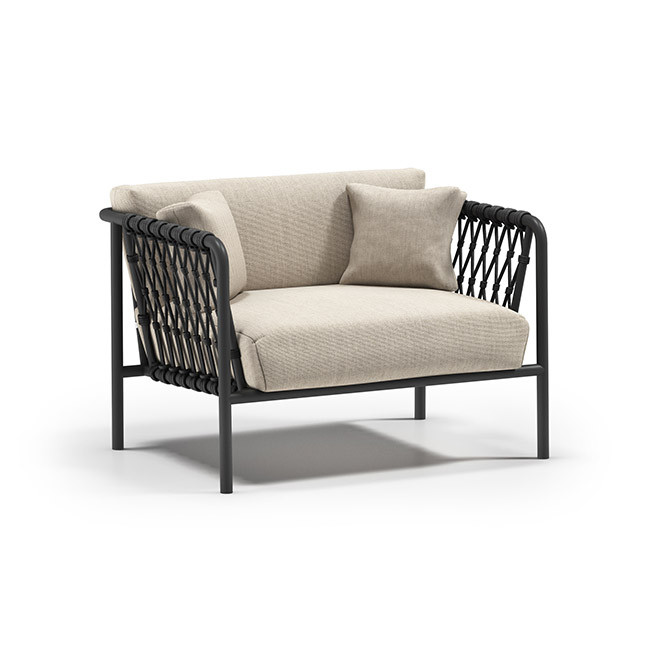
Rope seating has the same need for specific information. Yard Couture’s Rowan Club Chair combines handwoven weather-resistant rope with powder-coated aluminum and quick-drying DreamCore cushions. The listing illustrates how several materials work together, but it does not identify the exact rope fiber. Ask for that detail if exposure or cleaning requirements will determine your choice.
Choose Between Sling and Cushioned Seating
Sling furniture supports the sitter on fabric stretched across a frame. It can suit poolside or frequently wet settings because there is no loose seat cushion to take inside. Drying, support, and feel still depend on the particular sling construction; padded and double-layer designs are not all alike.

Cushioned seating offers a different feel and can work well for extended lounging. Compare the filling and drainage as carefully as the cover. A fade-resistant fabric does little to solve a cushion that stays wet inside, and a “quick-dry” claim needs to apply to the cushion construction rather than just its surface.
Look for information about cushion attachment, removable covers, filling, and replacement availability. Snap tabs or other attachments can keep cushions positioned during normal use, but they are not proof that the furniture can be left exposed during a storm.
What Solution-Dyed Fabric Means
Solution-dyed fabric has color incorporated into the fibers rather than applied only to the finished surface. Sunbrella’s fabric-performance explanation describes color and UV-stabilized pigments throughout its fibers, helping them resist fading through use and outdoor exposure.
Compare the exact fabric’s intended use, care instructions, and warranty. Solution dyeing is not a universal promise of fade-proof or waterproof furniture. The seams, filling, and cushion design also determine moisture behavior.
Evaluate Comfort Beyond the Product Photo
If you can try the furniture, sit as you would use it: upright for a meal, back against the support for conversation, or reclined on a chaise. Notice whether your feet reach the ground comfortably, the arms are useful, and getting up feels easy.
Online, compare the seat height, usable seat depth, back shape, arm height, and cushion construction with a chair you already like. Overall depth is not the same as usable seat depth. Dimensions help narrow the options, but they cannot reproduce a sit test or tell you how firm a cushion feels.
Swivel and rocking mechanisms need space to move. Reclining chaises need room in their extended position. Check that movement against nearby furniture, walls, and walkways, not just the piece’s static footprint.

For sectionals, confirm the exact modules and the manufacturer’s definition of left and right. The Urban Table Loveseat has separate left-hand and right-hand table options. Verify the selected version and any reconfiguration possibilities instead of assuming it can be reversed after delivery.

Match Care and Storage to Your Climate
Full sun makes fabric fade performance and surface temperature important. Dark finishes and cushions can become hot; shade may make the seating more usable, but shade equipment has its own mounting and wind requirements. Samples can help you judge texture and color before ordering.
Coastal air and pool environments place additional demands on finishes and hardware. Homecrest’s frame-care instructions call for more frequent maintenance in coastal settings to address salt residue and possible oxidation. Follow the selected manufacturer’s routine rather than assuming aluminum needs no coastal care.
Rain and humidity make drainage, drying, and cushion storage part of everyday use. In freezing climates, follow the storage instructions for the whole piece. Trapped water can damage hollow metal frames when it freezes; a cover does not correct an unsuitable storage position or blocked drainage.
Umbrellas Need a Separate Wind Plan
Use the wind and closure guidance for your exact umbrella, base, and mounting arrangement. An exposed rooftop and a sheltered patio call for different planning.
Treasure Garden’s umbrella safety guidance says umbrellas should never be left open unattended, regardless of size or weight. It recommends closing and storing them in windy conditions and following its model-specific support requirements. Choose the prescribed base or mounting system; neither cast iron nor a high purchase price establishes safe ballast for every umbrella.
Read “Commercial Grade” Alongside the Actual Terms
For a hotel, restaurant, office terrace, or shared amenity area, start with whether the manufacturer supports the intended commercial use. Then consider cleanability, weight limits, stacking or storage, replacement parts, and service requirements. If a product claims testing or certification, ask which standard and which model it covers.
The label “commercial grade” alone does not establish a particular certification or guarantee that residential and commercial warranties are identical. Homecrest’s written warranty, for example, separates those settings and gives different coverage to frames, finishes, slings, cushions, and other components. Registration requirements and exclusions matter too.
Residential buyers can also benefit from replaceable wear parts. Ask about replacement cushions, slings, glides, and mechanisms before purchase. Maintaining a sound frame is more useful when the parts that wear are still available.
Plan Furniture Around Fire Features and Cooking Areas
A fire table changes the usable seating area. Cushions, slings, rope, wood, and umbrella canopies can introduce combustibles into the layout. Keep them outside the clearance zone required by the exact appliance and applicable local rules, including overhead requirements. A metal chair frame does not make its fabric safe near a flame.
Yard Couture’s fire-pit placement guide explains why the manual, surface, fuel access, and local rules belong in that decision. Leave clear walking and service routes as well as comfortable seating positions.
For a grill or outdoor kitchen, keep chairs and shade equipment outside its required clearances and leave a usable route for serving. Planters can screen a seating area, but should not obstruct exits, appliance access, or circulation. Account for their loaded weight on elevated surfaces.
Compare Price by What You Are Buying
Compare equivalent pieces and included items, not just the finished photograph. Frame construction, fabric selection, cushions, motion mechanisms, and set composition can all change the price. A chair-only price and a complete dining-set price answer different questions.
Homecrest identifies its Allure sling collection as discontinued. The Yard Couture listing is a price and construction example, not a guarantee of current stock or factory production. Check the manufacturer’s collection status and confirm availability, replacement slings, and selected options with Yard Couture before ordering.
As price examples, Yard Couture listed the Allure Sling Aluminum Cafe Chair at $668 and the Elements Aluminum Adjustable Chaise at $1,363 on November 6, 2026. These are examples of two different products, not market-wide price benchmarks. Confirm the price for your selected finish, fabric, configuration, and included items when ordering.
Include delivery, assembly, covers, and likely replacement parts in the comparison. A warranty period is not a lifespan estimate, and neither a premium price nor a material name tells you how many years a piece will last on your particular patio.
Confirm Care and Delivery Before Ordering
Read the care requirements while comparing products. Gentle soap-and-water cleaning is common, but suitable detergents, brushes, stain treatments, and washing methods vary. Use the furniture and fabric manufacturers’ instructions for the selected piece.
Sunbrella’s upholstery-cleaning guidance says only some removable casings can be machine washed and advises consulting the furniture manufacturer before removal. It specifies air drying. It also notes that mildew can grow on dirt left on the fabric, so mildew resistance does not remove the need to clean it. Do not assume every zippered cover is washable or use a cleaning chemical simply because it is suitable for another outdoor fabric.
Let cushions and furniture dry before storage or covering, and use the manufacturer’s storage arrangement. Inspect fasteners, feet, finishes, slings, and moving parts as directed. Stop using seating with cracks, failed joints, or an unstable mechanism until the manufacturer or a qualified repair provider has assessed it.
For delivery, measure the route as well as the destination: gates, doorways, elevator interiors, stair turns, and the final access point. Ask for shipping-package dimensions and whether the furniture arrives assembled. Boxed dimensions may differ substantially from the assembled footprint.
Check the delivery charges, assembly arrangements, and damage-reporting procedures for the actual order. For truck freight, ask about curbside unloading and liftgate service. Confirm whether the quote includes carrying furniture upstairs or placing it on the patio. Review return and cancellation terms, especially for selected fabrics or made-to-order configurations. If the dimensions, materials, or order terms are unclear, ask Yard Couture for the missing product details before committing.