
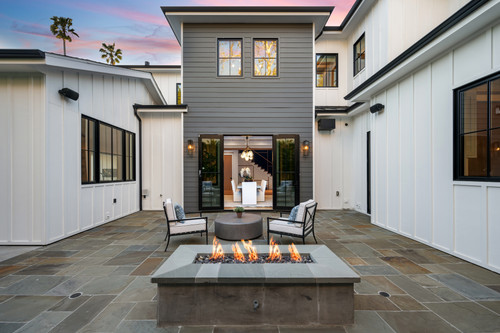
Fire Pit Placement: Clearances, Surfaces & Local Rules
Posted by Admin on 22nd Oct 2026
Where you place a fire pit should be decided before you choose its size, shape, or finish. The workable location depends on the exact appliance, the fuel it uses, the surface below it, what sits overhead, and the rules that apply at your address. Start with the clearance zone. Then test the surface, fuel access, wind, drainage, and circulation inside the space that remains.
Start with the manual and local authority. Ten feet is general consumer fire-pit guidance, not a code classification or universal clearance. The exact appliance manual and local rules may require a different, more restrictive setup. Confirm fire, building, property, and seasonal-restriction requirements before installation or use. Fuel-gas and electrical work belong with appropriately qualified professionals under local requirements.
Start With the Clearance Zone
The U.S. Fire Administration and the National Fire Protection Association both use at least 10 feet from a home or anything combustible as general outdoor fire-pit guidance. That is the right place to begin a site sketch, but it is not the only number you may encounter. The difference usually comes from how a local code classifies the fire and which code the community has adopted.
| Planning reference | Distance and how to use the reference |
|---|---|
| Consumer fire-pit guidance | Distance: At least 10 ft from anything that can burn How to use it: A general outdoor fire-pit baseline; use it to begin the layout, then check the appliance manual and local rules. |
| Salt Lake City 2021 IFC example: portable outdoor fireplace | Distance: Not within 15 ft of a structure or combustible material How to use it: A Salt Lake City 2021 IFC 307.4.3 example for a portable outdoor fireplace; follow the manufacturer’s instructions. |
| Salt Lake City 2021 IFC example: recreational fire | Distance: Not within 25 ft of a structure or combustible material How to use it: A Salt Lake City 2021 IFC 307.4.2 example for a defined recreational fire; eliminate conditions that could allow spread within 25 ft of a structure before ignition. It is not a universal rule for every fire pit. |
| Jurisdiction enforcing NFPA 1 for outdoor fires | Distance: 50 ft from structures How to use it: A code-dependent outdoor-fire requirement, not a generic fire-pit measurement. |
For the 15- and 25-foot examples, see Salt Lake City Fire’s published recreational-fire guidance. NFPA explains that jurisdictions enforcing NFPA 1 can require outdoor fires to be 50 feet from a structure, while its fire-pit education uses 10 feet from anything combustible. That distinction is why an internet search can return several different answers without any one of them being a safe substitute for your local rule.
When the plan is tight, do not treat 10 feet as a target to crowd. Larger wood fires, wind, dry vegetation, overhead conditions, and the exact appliance can all justify more separation. Before you pour a pad or order a feature, ask the local fire authority how it classifies the unit you intend to use. Check for temporary burn bans or seasonal restrictions again before every use.
Protect the Whole Zone, Not Just the House
A house is only one combustible edge. Deck railings, fences, sheds, furniture, cushions, dry grass, mulch, tree limbs, eaves, umbrellas, string lights, and low-hanging seasonal decorations can all change a seemingly open location. NFPA advises keeping fire pits away from siding, decks, railings, grass and other vegetation, as well as from eaves, branches, and rooflines. Sparks and embers can travel farther than the visible flame and ignite light combustibles such as dry leaves or fabric. NFPA suggests a minimum of three feet for supervising children and pets; follow the appliance manual and local rules for fixed clearances.
Covered patios and pergolas need a separate answer. Do not assume a gas feature is suitable under an overhead structure because it produces fewer embers than wood. Heat can build beneath combustible overhead materials when clearances or airflow are inadequate. Consult the manufacturer’s specifications and your municipal fire marshal to confirm ventilation and setback conditions. If the manual does not permit the setup, choose a different location.
Keep adult seating and circulation outside the manufacturer’s stated clearance area, with room to step away without crossing a flame or a hose. A spark screen can help contain sparks from a compatible wood-burning pit, but it does not reduce the required clearance.
Choose the Surface the Exact Unit Permits
The surface question cannot be answered by material alone. NFPA’s consumer guidance calls for an even, level surface that will not catch fire, such as patio blocks, bricks, or concrete. The product manual still determines whether a particular gas unit can sit on a combustible deck, needs a specified base, or is unsuitable for the proposed location.
| Surface | Placement considerations and installation checks |
|---|---|
| Wood or composite deck | What it means for placement: Do not treat it as a default fire-pit surface. Consider it only when the exact appliance instructions expressly permit it. What to confirm before installation: Manual requirements, any required base or barrier, and building, lease, HOA, and local rules. |
| Grass or bare soil | What it means for placement: Not a noncombustible default. Keep combustible vegetation out of the clearance zone and use only the surface arrangement the manual allows. What to confirm before installation: Unit stability, a level base, vegetation clearance, and model-specific fuel and surface instructions. |
| Concrete or pavers | What it means for placement: A sensible starting surface when it is level, stable, and allowed by the appliance instructions. What to confirm before installation: Manual surface requirements, drainage, unit weight, and any site-specific support needs. |
| Rooftop or balcony | What it means for placement: Project-specific rather than a standard yes-or-no answer. What to confirm before installation: Appliance instructions, building management, structural and wind considerations, and local authority conditions. |
Local rules can differ even across neighboring jurisdictions. For example, Arvada Fire Protection District’s published guidance describes restrictions for charcoal burners and other open-flame cooking devices on combustible decks or balconies, along with dwelling and sprinkler exceptions. Its separate LP-gas limits concern grills on decks and vary by municipality. These are cooking-device and grill examples, not blanket rules or approval for a non-cooking fire pit. Confirm the exact appliance, residence classification, and local authority requirements at your address; do not export a neighboring jurisdiction’s rule.
Let the Fuel Shape the Site Plan
Wood-burning fire pits
Wood requires the most conservative placement mindset because sparks, ash, smoke, and weather all become part of the site. NFPA advises using a metal screen over wood-burning fires, avoiding burning outdoors on windy, dry days, and checking local requirements before use. Fire restrictions can change quickly; a local fire district may treat a wood fire differently from a gas appliance, but you should never assume a gas device is automatically allowed. If fuel is still undecided, Yard Couture’s guide to wood, gas, and electric fire-pit types can help narrow the format before placement planning begins.
The Barrel Wood Burning Fire Pit is a dedicated wood-burning example with a steel base and internal grate. The linked listing offers a hinged barrel screen and drink rails as optional accessories. Use the product manual and local classification to plan its site; portability or a fitted screen does not make an otherwise unsuitable location acceptable.

Propane fire pits and fire tables
Start with the selected appliance documentation, because the model determines the compatible cylinder, enclosure, regulator, hose route, ventilation, and access requirements. With propane, placement also has to leave safe access for changing the cylinder and a hose route protected from foot traffic. NFPA notes that LP-gas container placement is governed by NFPA 58; the correct setup depends on the container and installation details, so do not replace the model documentation with a generic distance chart.
A concealed-cylinder design can keep the fuel out of the visual field, but it does not make every propane arrangement interchangeable. Treat the selected model’s compatible cylinder, access, and operating instructions as part of the site plan before choosing the final location.
The Propane Fire Table with Hidden Tank illustrates why cylinder access belongs in the layout. Its pullout drawer is designed for a standard 20 lb propane cylinder. Leave the access and ventilation required by the exact model, and confirm the cylinder and included components rather than assuming any concealed tank compartment will work.

Natural-gas fire pits
Start with the selected appliance documentation and the local plumbing or mechanical path. A natural-gas feature is usually planned as a fixed location because its fuel connection, accessible shutoff, and any ignition requirements need to work with the final layout. Those local requirements may differ from rules for a portable wood-burning fire pit. The U.S. Consumer Product Safety Commission lists ANSI Z21.97 / CSA 2.41 among voluntary standards for outdoor decorative gas appliances. That does not approve every appliance for every site. Confirm the exact product’s listing, fuel configuration, clearances, and installation instructions, then coordinate the gas and any electrical work with qualified professionals under local requirements.
The Contemporary Linear Gas Fire Pit by Yard Couture is available in natural-gas and propane configurations, with match-lit or electronic ignition choices. For a natural-gas installation, plan the final location around the selected unit’s fuel connection, accessible shutoff, ignition requirements, and service access. Choose the correct configuration; do not assume a fuel option permits conversion.

Read Wind, Water, and Access Before You Select a Size
Keep the clearances fixed, then use the site to decide which way the fire feature faces. NFPA recommends avoiding outdoor burning on windy, dry days. In ordinary conditions, prevailing wind still affects smoke, flame behavior, and where guests will be comfortable. Place the seating plan with that direction in mind, and do not block natural walking paths to doors, gates, or steps.
Drainage and service access matter as much as a good view. Set the feature only on a stable, level arrangement allowed by its manual, keep any required drainage features clear, and leave access to fuel connections, controls, and service panels. If the fire pit must be moved for a refill, covered for weather, or serviced after installation, that work should not require rearranging the whole patio.
Measure the usable footprint after you have applied the clearance zone, not before. The available area must still hold the unit, its required access, seating, and a clear path around the gathering space. Yard Couture’s fire-table buyer’s guide is a useful next read when fuel, furniture, and circulation need to work together.
Confirm These Points Before You Commit to a Spot
- Read the exact model manual for side, overhead, surface, fuel, ventilation, and accessory requirements.
- Confirm how the local authority classifies the planned fire feature and whether current burn restrictions affect its use.
- Check the full clearance zone for structures, fences, vegetation, furniture, overhead conditions, and shared-property rules.
- Verify that the selected surface and, where relevant, building or property conditions are acceptable for the exact model.
- Plan the propane arrangement or permanent gas connection before finalizing furniture, landscaping, or hardscape.
- Leave room for service access, weather protection, and safe movement around the feature.
Choose the Fire Pit After the Site Is Clear
The reliable order is simple: establish the local and model-specific clearance zone, test the surface and overhead conditions, plan the fuel and access, then select the fire pit that fits the remaining space. That process does not guarantee approval or safe operation on its own, but it prevents a purchase from driving a site decision that the manual or local authority will not support.
When the site brief is clear, compare current gas fire pits or the broader fire-pit collection only against the exact model specifications and the prepared site. For a nonstandard location, size, or material direction, contact Yard Couture with the site dimensions, fuel availability, and known constraints.
Product images illustrate specific models, finishes, and accessories, not approved placement layouts or measured clearances. Confirm current product details and the exact appliance instructions, then have the planned site reviewed under the requirements that apply at your address.