
Fire Table Buyer’s Guide: Fuel, Size & Materials
Posted by Admin on 19th Oct 2026
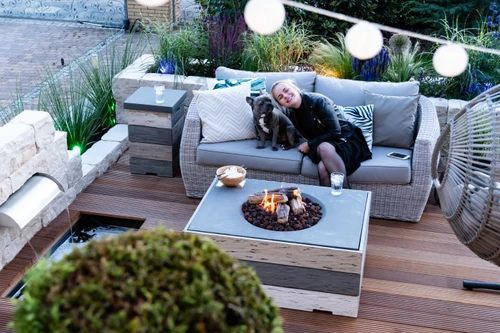
A fire table gives an outdoor seating area two jobs in one footprint: a live flame when the table is in use and a usable surface when it is not. That makes the format a practical alternative to a fire bowl or low fire pit for patios where drinks, plates, and circulation matter as much as the flame.
The right choice starts with the constraints of the site, not the finish. Fuel determines how and where the table can be supplied. The furniture layout determines the size and height. The unit’s published instructions, listing, local authority, and product specifications determine whether the planned surface, overhead conditions, and accessories are acceptable.
Safety note: A fire table is an outdoor gas appliance, not a general construction project. The appliance manual and local code are the final authorities. Do not attempt gas-line installation, fuel conversion, regulator replacement, pressure testing, or electrical work yourself; these tasks, along with any site-specific structural review, belong with appropriately qualified professionals.
Start With Four Decisions
- Choose propane when a compatible table and cylinder arrangement suit the site and a fixed natural-gas line is not practical.
- Choose natural gas when the table is part of a permanent plan and an approved fuel connection can be provided for the exact unit.
- Choose height and shape around the seating you already own, the usable tabletop you want, and the walking routes that must remain open.
- Choose material around the finish behavior, surface below it, climate, care expectations, delivery route, and the actual unit’s weight.
Those decisions are more useful than beginning with a color or a maximum BTU number. Yard Couture’s fire-pit and fire-table collection shows the range of forms and materials available, but compare current product documentation before treating any configuration as interchangeable.
What Makes a Fire Table Different?
A fire pit or bowl puts the flame at the center of the experience. A fire table adds a surrounding top that can support a more furnished patio layout. The usable edge, burner position, and table height vary by model, which is why a fire table may suit a lounge area, a dining area, or a compact terrace better than an open bowl.
That does not make every fire table a dining table, or every burner cover a general-purpose serving surface. Confirm the intended use, cover, and accessory compatibility in the product information for the specific table. If you are still deciding between fuel types and broad fire-feature formats, Yard Couture’s guide to fire-pit types offers a wider comparison.
Propane or Natural Gas?
Fuel is the first major decision because it affects supply, placement, project scope, and ongoing use. Neither option is universally better. The right one is the one that fits the property and the exact appliance without asking the site to become something it is not.
| Planning factor | Fuel options and planning considerations |
|---|---|
| Fuel supply | Propane fire table: A compatible portable cylinder or other propane supply, managed according to the appliance instructions. Natural-gas fire table: A fixed fuel connection designed for the chosen unit. |
| Placement | Propane fire table: May offer more layout flexibility, but the cylinder, enclosure, regulator, ventilation, clearances, and access still have to match the model. Natural-gas fire table: Usually planned around the approved gas-connection location and the appliance’s installation requirements. |
| Project scope | Propane fire table: Requires a compatible appliance, approved cylinder arrangement, and ongoing refills or exchanges. Natural-gas fire table: Requires a qualified gas professional, appropriate permitting or inspection where required, and a site-ready fuel connection. |
| Best fit | Propane fire table: A gas-fire plan where a permanent natural-gas connection is not practical and the selected model supports the intended arrangement. Natural-gas fire table: A fixed patio or landscape plan with suitable gas service and professional installation. |
Do not assume a propane table can be converted to natural gas, or that a similar-looking model uses the same cylinder arrangement. Conversion, fuel type, regulator, burner, enclosure, and installation requirements are unit-specific. The same applies to operating cost: local utility and propane pricing, burner input, and how often the table is used matter more than a generic fuel-cost claim.
For a concealed-cylinder example, the Propane Fire Table with Hidden Tank has a pullout drawer designed for a standard 20 lb propane cylinder. Its metal choices include powder-coated aluminum, Corten steel, and mild steel. The concealed drawer simplifies the appearance, but tank access, ventilation, and the exact cylinder arrangement still belong in the site plan.

Size the Table Around the Furniture and Circulation
Measure the patio with the seating in its real position, not tucked under itself for a product photo. A plan needs room for chairs to move, guests to pass, and the clearances in the appliance manual. The footprint may look comfortable when the chairs are empty, then feel cramped once people sit down and someone needs to get through the space.
Height matters just as much as length or diameter. A lower, coffee-height table can work well with deep lounge seating. A taller table may align better with dining or counter-height chairs. Compare the table’s finished height with the seat height and arm height of the furniture already in the space. The most impressive flame line is still frustrating if the tabletop blocks conversation or the seating feels mismatched.
Burner placement shapes how the top works. A long center burner can create a strong visual line, while an inset or offset burner may leave more useful landing space on one side of the flame. Look at the product drawing, not just the overall table dimensions, and confirm which portions of the top are intended to be used when the appliance is off.
The Palisades Gas Fire Table illustrates why footprint and height should be checked together. Its current published dimensions are 52 inches long, 36 inches wide, and 21 inches high. Compare that height and the central burner opening with your actual lounge seating, rather than assuming a fire table will work with standard dining chairs.

Understand BTU Ratings Without Treating Them as a Comfort Promise
A BTU rating describes fuel input, not a guaranteed patio temperature. It can help compare burner capacity, but perceived warmth depends on wind, outdoor temperature, the table’s flame setting, seating distance, nearby walls, and the layout of the space. Wind in particular disperses heated air, so a breezy site can feel much cooler than a sheltered one with the same burner rating. A fire table can extend an evening and provide a visible focal point; it should not be selected as a substitute for a dedicated heating plan.
A common 20-pound propane cylinder holds about 4.6 gallons when full, according to AmeriGas’ tank-size guide. Ferrellgas notes that propane contains about 91,500 BTUs per gallon.
Using those published figures, a full cylinder represents approximately 420,900 BTUs of fuel energy. Dividing that energy by a continuous burner input gives about 8.4 hours at 50,000 BTU/hour or about 6.5 hours at 65,000 BTU/hour.
These are idealized energy calculations, not guaranteed run times. Actual operating time depends on cylinder fill level, burner input, flame setting, weather, and fuel-system conditions. Confirm the selected unit’s documentation and the actual cylinder supply rather than using these examples as an appliance-runtime promise.
If frequent propane use is likely, plan the refill or exchange routine before purchase. Never apply external heat to a cylinder or place a spare cylinder near a heater, flame, or other ignition source. Follow the unit’s instructions and consult the fuel supplier if performance or storage is a concern.
Match the Material to the Site
Material affects visual character, maintenance needs, delivery handling, and the relationship between the table and the hardscape beneath it. It does not replace the appliance’s safety, clearance, or installation instructions.
| Material direction | Material behavior and model checks |
|---|---|
| Powder-coated metal | What to consider: A controlled color finish that needs sensible cleaning and attention to chips or scratches. What to verify on the chosen model: Finish-care instructions, exposure suitability, the unit’s construction, and any touch-up guidance. |
| Weathering steel | What to consider: A changing rust-toned patina that can suit a natural material palette but may produce rust-colored runoff. What to verify on the chosen model: The drainage path, the surface below, nearby stain-sensitive materials, and expected finish behavior. |
| Aluminum | What to consider: A metal option often selected where lower weight or a powder-coated finish is preferred. What to verify on the chosen model: The exact unit weight, wind stability, finish-care requirements, and its suitability for the site. |
| GFRC or concrete | What to consider: An architectural, substantial form with product-specific weight and finish characteristics. What to verify on the chosen model: Delivery access, supporting surface, drainage, freeze-thaw guidance, and the manufacturer’s care requirements. |
Weathering steel develops a protective rust-like patina under alternating wet-and-dry conditions, but the pace and final appearance vary with exposure. SSAB’s weathering-steel guide explains that site conditions influence this process. If a weathering-steel fire table will sit near pale concrete, porous stone, decking, or another stain-sensitive surface, plan for runoff before placement. Yard Couture’s guide to protecting hardscape from Corten runoff provides related site-planning context.
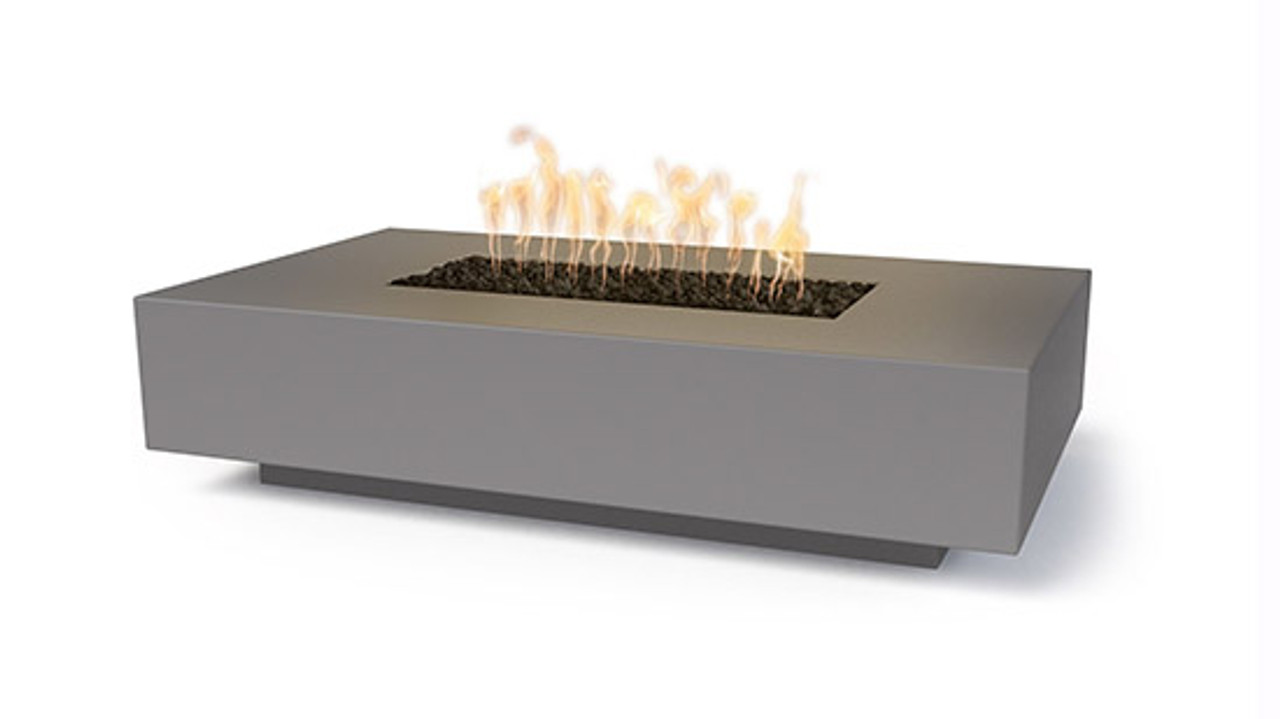
For a GFRC concrete alternative, the Linear Cabo Fire Pit by The Outdoor Plus offers a low rectangular table form with a surrounding top. Its fuel choices include natural gas and propane, but the listing specifies that the propane version uses a hard-line supply and does not conceal a BBQ tank. Confirm the chosen configuration, finish, dimensions, and site requirements before comparing it with a concealed-cylinder model.
Ignition, Media, Lids, and Wind Guards
Match-lit and electronic ignition systems have different controls, components, and care requirements. Neither should be judged by a generic description alone. Compare the exact fuel configuration, ignition system, shutoff arrangement, burner, and documentation before ordering; a similar table top may be paired with different hardware.
Fire glass, lava rock, and ceramic logs are appliance components as well as visual choices. Use only the media type and depth allowed by the manufacturer. Do not substitute decorative stone or overfill the burner pan. If a wind guard, rigid lid, canvas cover, or snuffer is available, confirm that it is designed for the exact opening and follow the instructions for removal, use, and cool-down. Accessory compatibility belongs with the unit’s product information and instructions.
The Contemporary Linear Gas Fire Pit by Yard Couture offers natural-gas and propane configurations, match-lit or electronic ignition, and an optional matching lid and glass surround. The photo below shows the Corten version with its matching lid in place, illustrating one product-specific cover design. A pictured lid is not a universal accessory or permission to cover an operating burner.

Clearances, Covered Patios, and Local Rules
Do not choose a table until you know whether it can be used at the planned location. The National Fire Protection Association’s general outdoor-fire guidance recommends at least 10 feet between a fire pit and anything that can burn, a level noncombustible surface, clear paths, and supervision. That is educational guidance, not a substitute for local law or the model’s specific clearance requirements; either may be stricter.
A covered patio, pergola, deck, rooftop, or other constrained site needs more than a general rule of thumb. Confirm the exact appliance’s manual, its listed surface and overhead requirements, the local authority’s rules, and any structural or fuel-gas scope before ordering. A unit may not be listed for the planned covered condition at all; if it is not, do not use it there. Gas does not automatically make a feature acceptable under a roof or on a deck.
The U.S. Consumer Product Safety Commission lists ANSI Z21.97/CSA 2.41 as a voluntary standard for outdoor decorative gas appliances. Product documentation should identify whether the selected unit is listed to an applicable standard; a standard’s existence does not prove that every product is listed or suitable for every site.
For portable cylinders, follow the appliance, cylinder supplier, and local requirements. As one jurisdictional consumer-safety example, North Carolina directs consumers to store propane containers outdoors, upright, and away from flames or other ignition sources; it also warns against indoor storage. See its propane-container storage guidance for the rationale. Local codes may add requirements.
Care That Protects the Finish and the Burner
Let the appliance cool fully before covering or servicing it. Keep any manufacturer-provided drainage and burner areas clear of debris, and use a fitted cover or lid only as directed. Before each season, inspect the table and accessories using the manual’s process; if a gas odor, damaged hose, deteriorated component, or other concerning condition appears, stop use and contact a qualified professional or the manufacturer’s support channel.
Yard Couture’s care guide offers general material and fire-feature guidance, including the difference between weathering steel, powder-coated finishes, mild steel, stainless steel, copper, and GFRC. The selected product’s care documentation remains the final authority because finish, burner, cover, fuel, and site conditions can change what is appropriate.
Before Ordering a Fire Table
- Confirm the fuel available at the intended location and the exact appliance configuration.
- Measure the table footprint with real seating positions, walkways, and required clearances in the plan.
- Compare table height, burner position, usable tabletop area, and cover design with the way the patio will be used.
- Check the model’s manual for the planned surface, overhead conditions, accessories, and local approval requirements.
- Review material behavior, drainage, delivery access, loaded weight, and the supporting surface before placement.
- Plan cylinder access or fuel-gas work, ongoing care, and off-season protection before the table arrives.
Choose the Table That Fits the Site
The best fire table is not necessarily the largest burner or the most elaborate finish. It is the one that fits the fuel path, seating layout, surface, climate, maintenance expectations, and local requirements without asking you to compromise on safety or circulation. Start with the constraints, then choose the flame format and material that make the outdoor space more useful.
Compare current gas fire pits and fire tables against the specific product documentation when you are ready to narrow the options. For a custom project, contact Yard Couture with approximate dimensions, fuel availability, surface details, and any site constraints.
Product photographs show selected finishes and configurations. Confirm current fuel choices, ignition, dimensions, included components, accessories, and installation instructions on the individual product page and in the appliance documentation before ordering.