
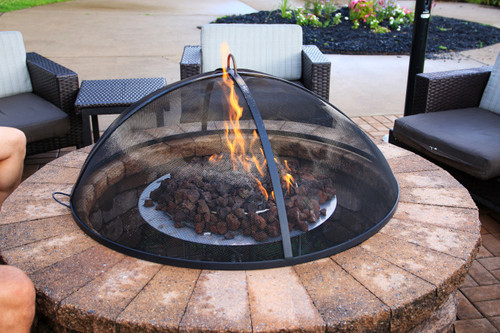
Types of Fire Pits: Wood, Gas & Electric | Yard Couture
Posted by Admin on 12th Oct 2026
A fire pit is not one product category with a single set of rules. The fuel, installation, flame format, material, and site all change what will work. A wood-burning bowl, a natural-gas fire table, a propane unit with a concealed tank, and an electric flame-effect feature may all be called fire pits, but they solve different problems.
Start with the space and the utility options, not the shape of the fire feature. The right choice is the one that fits the location, local requirements, appliance instructions, and the way you expect to use it.
Quick Answers
What are the main types of fire pits?
The main fuel choices are wood, natural gas, propane, electric, and alcohol-based options such as bioethanol or gel fuel. Fire tables, bowls, torches, and fire-and-water features are formats that may use one of those fuels.
Which fuel is easiest to place?
Wood needs no fuel connection, while a compatible propane model may offer more placement flexibility than natural gas. Every option still needs the clearances, surface, and use conditions required by its manufacturer and local authority.
Is natural gas or propane better?
Natural gas often suits a fixed installation with an approved fuel line. Propane can suit locations without a natural-gas line, but the selected appliance, tank arrangement, enclosure, and ventilation requirements matter.
Can any fire pit go under a covered patio?
No. Use a fire feature under a cover only when the exact appliance instructions and local requirements allow that installation.
Are gas fire pits automatically exempt from burn restrictions?
Do not assume so. Restrictions and fire-danger rules vary by community and can change with conditions; check with the local fire authority before use.
Before purchase or installation: confirm the exact appliance manual and local fire-authority requirements for the planned site.
Choose the Fuel Before the Format
The first choice is usually the fuel source. It determines whether the feature needs a permanent gas connection, how much tending it requires, what must be stored nearby, and how readily the feature can move. It also affects which models are appropriate for the site.
| Fuel type | Use and planning considerations |
|---|---|
| Wood | Often suits: Traditional outdoor-fire atmosphere, where local rules and the site permit it. Key planning considerations: Clearance, dry firewood storage, tending, smoke, sparks, ash, and burn restrictions. Confirm before ordering: Local rules, approved use surface, spark-screen requirements, and model-specific clearances. |
| Natural gas | Often suits: A permanent outdoor feature near a suitable fuel line. Key planning considerations: Qualified gas work, appliance location, shutoff access, permits, and the selected ignition system. Confirm before ordering: Fuel configuration, listed installation requirements, certification, clearances, and contractor scope. |
| Propane | Often suits: Gas flame where a fixed natural-gas line is impractical. Key planning considerations: Compatible tank type, tank access, regulator and hose routing, enclosure ventilation, and refills. Confirm before ordering: Whether the selected model is tank-fed, uses a larger supply, or can be converted. |
| Electric | Often suits: Projects seeking a flame-effect feature without combustion. Key planning considerations: Dedicated electrical requirements, weather rating, and whether warmth or visual ambience is the priority. Confirm before ordering: Outdoor listing, power requirements, heat output, and placement instructions. |
| Bioethanol or gel fuel | Often suits: Smaller decorative features designed for their specific fuel system. Key planning considerations: Approved fuel, refill and cool-down instructions, ventilation, spill risk, and local restrictions. Confirm before ordering: The manufacturer’s fuel, placement, refueling, and use instructions. |
Wood-Burning Fire Pits: The Traditional Option
Wood burning gives you the crackle, aroma, embers, and hands-on rhythm people associate with a campfire. It also means storing dry firewood, lighting and tending the fire, removing cooled ash, and planning around smoke and sparks. For examples of bowls, screens, and smokeless options in several metals, see the Yard Couture wood-burning fire-pit collection; materials and features vary by model.
The Barrel Wood Burning Fire Pit is a dedicated wood-burning example with a steel base and internal grate. Compare optional accessories and follow its placement and use instructions rather than treating portability as permission to use it anywhere.

Smokeless Models Still Need Normal Fire-Pit Planning
Many smokeless wood fire pits use a double-wall airflow design to support secondary combustion, which may reduce visible smoke after the fire is established. Results vary with the fuel, airflow, weather, and how the fire is managed. A smokeless design does not replace local rules, safe placement, supervision, or any screen required by the appliance instructions or local authority.
Natural Gas and Propane: Two Ways to Use a Gas Fire Pit
Gas fire pits can offer a controlled flame without firewood storage or ash cleanup. They are not interchangeable, however. The fuel configuration, burner, regulator, enclosure, ignition, and installation instructions must all match the exact appliance.
Natural Gas: Best Suited to a Fixed Plan
A natural-gas fire pit is typically planned around a fixed location and a properly designed fuel connection. It can make sense for a patio, outdoor kitchen, or landscape feature that will remain in one place. Have gas connections, permits, electrical work, clearances, and final placement handled by appropriately qualified professionals under local requirements and the appliance documentation.
Yard Couture’s gas fire-pit fuel and ignition options describe natural-gas, propane, match-lit, and electronic-ignition choices across selected models. Treat it as a starting point for comparison, then use the chosen product page and its manual to confirm the final configuration.
Propane: Flexible, but Still Product-Specific
Propane may make a gas feature possible where a natural-gas line is not practical. Some models use a portable cylinder; others are designed around a larger propane supply. A concealed tank compartment can simplify the appearance, but it does not eliminate the need to follow the model’s requirements for the tank, regulator, hose, access, and ventilation.
For a concealed-cylinder example, the Propane Fire Table with Hidden Tank has a pullout drawer designed for a standard 20 lb propane tank. It illustrates why tank access and the exact cylinder requirements belong in the buying decision. Verify the selected configuration and what is included before purchase.

Cold weather can affect propane vaporization and the performance of a tank-fed appliance. The Ferrellgas cold-weather propane guidance notes that very low temperatures can affect vaporization. Do not attempt to heat a propane tank with an improvised heat source; consult the appliance instructions and propane supplier if cold-weather performance is a concern.
Fire Tables, Fire Bowls, and Other Formats
Fuel tells you how the feature is supplied. Format tells you how it works in the landscape.
Fire Tables
A fire table combines a burner with a usable table-height surround. It can suit an entertaining area when the seating plan, clearance requirements, and the exact appliance instructions allow it. Some models are designed around natural gas, while others are offered in propane configurations; the same shape does not guarantee the same fuel or ignition options. The hidden-tank propane fire table pictured above is one example of this format, not evidence that every fire table accepts the same fuel or cylinder.
Fire Bowls
Fire bowls prioritize a sculptural flame and can work as a standalone focal point or as part of a larger landscape composition. Depending on the model, a bowl may be offered for wood, natural gas, propane, or more than one of those options. Compare the exact fuel configuration rather than assuming a bowl shape determines how it operates.
The Fire Pit Bowl illustrates the difference between shape and fuel: its choices include natural gas, propane, and wood burning, with wood limited to Corten or mild steel. Choose the correct fuel-and-material configuration from the outset.

Fire-and-Water Features
Fire-and-water bowls combine a gas burner with a water element. They add visual complexity and can require coordinated planning for gas, water, drainage, surface support, and access for service; associated equipment may also have electrical requirements. The Yard Couture water-and-fire features collection is a useful place to compare the forms available; the product manual and project team should determine the installation approach.
The Maya Fire & Water Bowl in GFRC concrete combines a gas-fire element with a copper water spillway. Its fuel and ignition choices need to be coordinated with the water system and site plan; it is not the same product as a water-only bowl.

Gas Tiki Torches
Gas tiki torches move the flame upward, which can make them useful as vertical accents near a path, pool area, or outdoor gathering space. They are not simply decorative oil torches with a different fuel. Their permanent or surface-mounted installation, fuel source, ignition, clearances, and local rules need to be verified for the selected model. See the current gas tiki torch collection for examples of natural-gas and propane configurations.
Electric, Bioethanol, and Gel-Fuel Options
Electric fire features use power rather than combustion. They can create a visual flame effect and, depending on the product, supplemental heat. Bioethanol and gel-fuel products create a real flame with a fuel reservoir or canister. These are broader-market options rather than current Yard Couture collection categories.
Neither category is a shortcut around product instructions. Electrical listings, indoor or outdoor suitability, ventilation, approved fuel, refueling procedures, surface protection, and local restrictions remain specific to the model. Do not use a product in a covered, enclosed, or semi-enclosed space unless its instructions explicitly permit that setting.
Material Changes the Maintenance and Site Plan
Material affects the appearance, weight, finish behavior, delivery plan, and relationship between the fire feature and the hardscape around it. It does not override the appliance’s installation or safety requirements.
| Material | Expected behavior and planning needs |
|---|---|
| Powder-coated aluminum | What to expect: A lighter metal option with a controlled color finish. Plan for: Finish care, wind stability, model-specific heat design, and suitability for the exposure. |
| Corten weathering steel | What to expect: A changing rust-toned patina that develops under suitable wet-and-dry exposure. Plan for: Rust-colored runoff near light or porous hardscape, plus the site conditions that influence patina development. |
| Mild steel | What to expect: Raw mild steel typically develops a natural rust finish outdoors over time. Plan for: Finish change, corrosion exposure, and maintenance expectations for the selected product. |
| GFRC concrete | What to expect: An architectural concrete form with its own finish and weight characteristics. Plan for: Delivery access, surface support, drainage, finish variation, and cold-climate instructions. |
| Copper or stainless steel | What to expect: Distinct metal finishes that can suit a more specialized design direction. Plan for: Metal grade, cleaning method, expected patina or finish behavior, and exposure conditions. |
Weathering steel is formulated to develop a protective, rust-like patina under alternating wet-and-dry conditions. The SSAB guide to weathering steel explains that the pace and final appearance depend on the site conditions. If Corten will sit near pale concrete, stone, decking, or other stain-sensitive surfaces, plan for runoff before final placement. Yard Couture’s guidance on protecting hardscape from Corten runoff provides a relevant site-planning example.
Safety, Clearances, and Local Rules Come Before a Purchase
Important: Installation and safety requirements are model-specific. Follow the appliance manual and local authority requirements, and use appropriately qualified professionals for fuel-gas or electrical work.
Use the outdoor fire pits discussed here outdoors only, and treat online rules of thumb as a starting point rather than a substitute for the exact model manual or local law. The National Fire Protection Association’s fire-pit guidance uses 10 feet from anything that can burn as a minimum educational recommendation and advises level noncombustible ground and clearance from overhangs. Local requirements or the appliance manual may require more. NFPA also emphasizes avoiding outdoor burning on windy, dry days and checking local requirements before use.
For gas appliances, the U.S. Consumer Product Safety Commission identifies ANSI Z21.97 / CSA 2.41 as a voluntary standard for outdoor decorative gas appliances. That does not mean every appliance is listed or suitable for every site. Confirm the exact product’s certification, fuel type, clearances, ventilation needs, and installation instructions before work begins.
Questions to Answer Before Choosing a Fire Pit
- What fuel and utilities are actually available at the intended location?
- Does the exact model permit the planned surface, overhead conditions, and placement?
- What local rules, permits, seasonal restrictions, or fire-danger conditions apply?
- Do you want to tend wood and remove ash, manage propane refills, or plan a fixed natural-gas installation?
- Does the material suit the hardscape, climate, drainage path, and expected finish change?
- Who will handle delivery, gas or electrical work, final placement, and any required inspection?
Choose by Constraints, Not by Flame Style
A wood-burning fire pit may be right for a traditional outdoor-fire experience where the site and local rules allow it. Natural gas can suit a permanent, planned feature. Propane may fit a gas-fire project without a practical natural-gas line. Electric and alcohol-based options serve more specialized needs and must be evaluated by their individual instructions.
Product images show specific finishes and configurations. Confirm current materials, fuel choices, ignition, included components, and installation instructions on the linked product page and in its documentation before ordering.
For a closer look at gas-specific choices, read Yard Couture’s gas fire-pit buyer’s guide. To compare current fire-pit forms and configurations or discuss a custom project, contact Yard Couture with the planned location, approximate dimensions, fuel availability, and any site constraints.